
Treating R2v3 readiness like an audit project is usually where the problem starts.
The pattern is familiar. The audit gets closer, documents get checked, reports are pulled from different places, missing records get chased down, and the team tries to clean up the compliance story at the end.
That is a hard way to run compliance.
If the operation is ready, the evidence should already exist. Not because someone prepared a folder before the audit, but because the workflow produced the right records as the work happened.
That is the practical difference.
R2v3 readiness is not about looking organized at audit time. It is about running the operation in a way that creates traceability, enforces required steps, and keeps evidence clean by default.
The common mistake
A lot of teams still treat R2 as a certification milestone.
But R2v3 is built around what a facility actually does. The requirements that apply depend on the real work being performed, whether that is data sanitization, test and repair, brokering, downstream management, or materials recovery.
So the better question is not:
How do we prepare for the audit?
It is:
Does our operation produce the evidence the audit will ask for without extra effort?
If the answer is no, the issue is probably not audit prep. It is process design.
What R2v3 tests in practice
At a practical level, R2V3 does not reward paperwork assembled after the fact. It rewards control during the work.
- Can you show which processes are in scope?
- Can you show that the right requirements apply to the work being performed?
- Can you show that required controls were followed?
Those questions are not answered by a policy alone. They are answered by records, workflow discipline, and traceability.
That is why R2v3 readiness has to live in the operation.
A clear example: data sanitization
Data sanitization is a good example.
If sanitization records depend on manual entry, memory, or reconstruction later, the process is exposed.
If serial capture is inconsistent, if unique identifiers are not tied cleanly to the asset record, or if verification is hard to prove quickly, the issue is not “audit readiness.” The issue is weak evidence.
And the same logic applies beyond sanitization.
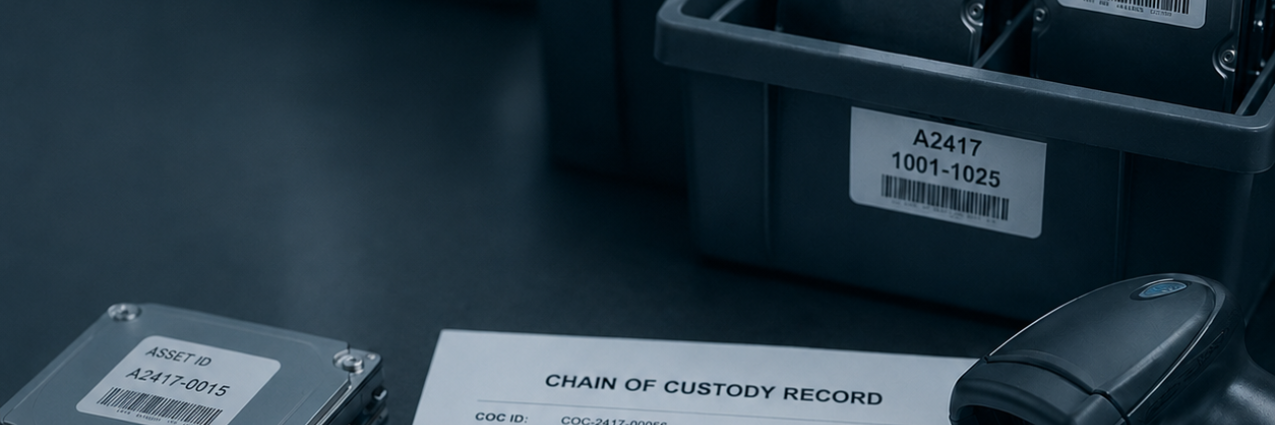
Chain of custody, routing decisions, downstream controls, reporting, and final certificates all rely on the same principle: the record needs to be produced as the work moves, not rebuilt after the fact.
Why this matters more now
The environment around R2V3 is getting tighter.
The standard is under formal review, and broader e-waste controls are putting more pressure on classification, routing, downstream handling, and supporting records.
For operators, that means there is less room for loose process control.
If shipment information is disconnected, if downstream records are difficult to retrieve, or if assumptions need to be explained after the fact, the audit conversation gets harder than it needs to be.
The cleaner the workflow, the easier it is to hold the proof.
What good readiness looks like
Good R2v3 readiness looks operational.
It looks like:
- records captured as work happens
- required steps enforced in the workflow
- unique identifiers carried through the process
- chain of custody that does not depend on manual reconstruction
- audit evidence generated from system activity, not cleanup effort
That is what makes compliance repeatable.
It also changes the audit itself. Instead of scrambling to prove what happened, the team is reviewing records that already exist because the process required them to exist.
Why this is also a business issue
This is not just about passing an audit.
Weak evidence creates drag across the business.
Teams spend more time chasing missing information. Reporting becomes manual cleanup. Customer questions take longer to answer. Exceptions sit longer than they should. And when proof is slow or incomplete, trust drops quickly.
That is why R2v3 readiness should not sit off to the side as a compliance project.
It should live in the same operating system that manages the work.
Making readiness part of the workflow
This is where purpose-built ERP matters.
For ITAD, recycling, and resale teams, R2v3 readiness depends on whether the system can keep work and evidence connected as assets move through the business.
Makor ERP supports that by helping teams manage asset-level traceability, required workflow steps, chain-of-custody visibility, sanitization records, downstream documentation, reporting, certificates, and customer-facing proof in one connected operational flow.
That matters because audit readiness should not depend on someone rebuilding the story after the fact.
It should come from the same system that manages the work every day.
The takeaway
R2v3 readiness is not something you bolt on before an audit.
It is the result of running the operation in a way that produces the right evidence by default.
If your team has to stop and rebuild the story of what happened, the workflow is doing too little.
The strongest compliance posture is not being well documented at the end.
It is being well controlled from the start.
About Makor ERP™
Makor ERP™ is the leading enterprise software for ITAD, recycling, and refurbishment operations, purpose-built to deliver full lifecycle visibility, regulatory compliance, and operational excellence.
Makor ERP
Engineered for Growth. Trusted for Compliance.